skip to main |
skip to sidebar
Southeast Arizona Trip ReportI'm breaking with my usual once monthly posting format to report on a trip to SE Arizona (Portal area) that I took at the beginning of May, the height of Spring Migration. It seems like it would be just too much to combine all the photos from this trip with whatever else might happen in May. In addition to loads of bird photos, I have just a few sketches of some birds that I wasn't able to photograph. That story later.
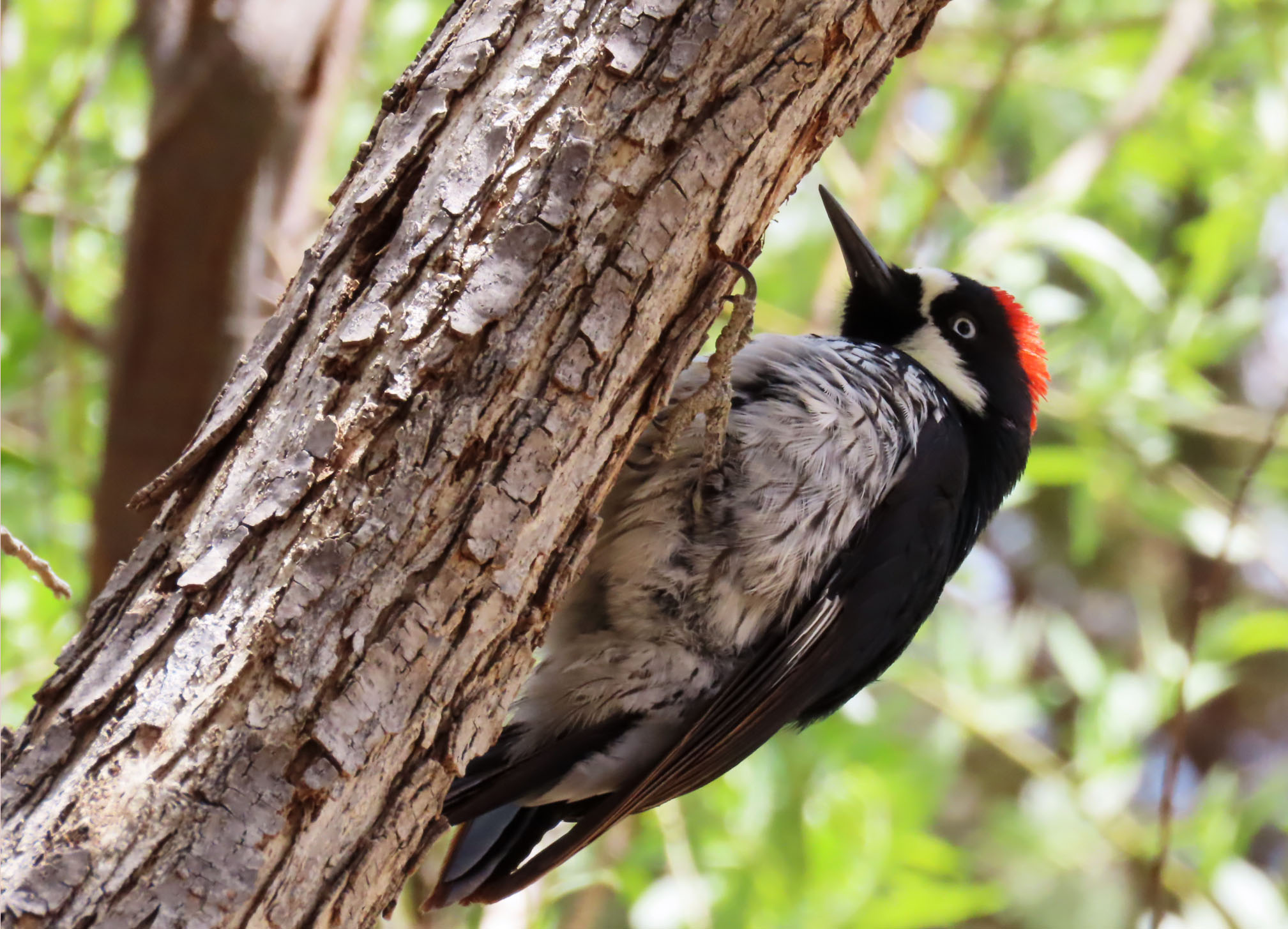
Southwestern Research StationI stayed at the Southwestern Research Station. There was so much bird activity right at the research station that I spent most of the time right there on the grounds. The first thing you hear when you arrive at the research station are the raucous calls of the Acorn Woodpeckers as they chase each other through the trees.
Ground Feeders (of all Kinds) On my first morning, I looked out from my window to find a flock of Wild Turkeys foraging on the lawn outside my room. Two males followed the females around, strutting in a full display of their wild regalia. This male was right outside my window for awhile. I was mesmerized watching the way he strutted with short quick steps, quivering his feathers. "Right outside my window" became a recurring theme: Throughout my stay, I looked out my window frequently whenever I was inside, and there were almost always one or more birds foraging on the lawn. From top to bottom: Chipping Sparrow, Green-Tailed Towhee, Lark Sparrow, Lincoln's Sparrow. (Poor photo quality due to shooting through the window.) 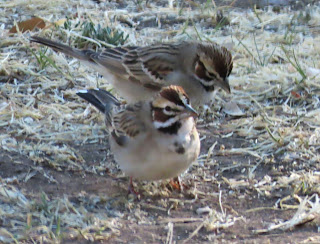  Each morning, I would walk around the grounds, observing the bird activity. Many of the birds I was seeing each morning may have come in overnight, stopping for a rest on their migration. Perhaps that partly explained the unusual behavior of many of the birds. Birds that are normally rather hard to see as they move through the trees, birds that I have never before seen out in the open, or on the ground, were spending much of their time foraging on the ground to eat the seedpods that were being blown out of the trees by the wind. The wind was supporting them in an easy energy-saving way to fuel up for their journey, I guess. Top to bottom, Western Tanager male, Wilson's Warbler
male, and, most astonishingly, a Yellow-Breasted Chat collecting
seedpods from both the ground and the roof.
FlycatchersJust about everywhere I looked, there would be a
small flycatcher perched low to the ground to stake out insects. As far
as I could tell they were mostly Hammond's and Dusky Flycatchers, but I
did see one Gray and one Willow Flycatcher.
Vermilion Flycatchers were prominent, mostly female. (I got one quick glimpse of a bright red male, and also saw a couple of fledglings.) SWRS Hummingbird StationThe Southwestern Research Station does Hummingbird banding research, and accordingly has a very nice Hummingbird feeder area. The area was bustling with Black-Chinned, Broad-Billed, Rivoli's Hummingbirds, and Blue-Throated Mountain Gem. We got to observe the banding one morning. Photos show a bander examining a Rivoli's Hummingbird's skin by blowing on his feathers with a straw, then bringing him to nectar for re-hydration before releasing (The Blue-Throated Mountain Gem you can recognize by the blue throat, and the Rivoli's is the one with the amazing green gorget.)
 B
The Pond: My Favorite Spot
On a trail behind the buildings at the SWRS, I found a couple of small stagnant ponds. (I believe these are kept irrigated in spite of the drought due to this being one of the few breeding areas for the rare Leopard Frog.) One had a bench beside it, making it perfect as a place where I could sit comfortably for awhile and just observe. A Black Phoebe worked the surface of the pond to catch insects. A Chipping Sparrow landed at the edge of the water for a drink. There was a tree to the left of the bench, four feet away from me.
A
Brown Creeper landed on the trunk right at my eye level and took my
breath away. I wouldn't have dreamed of spoiling the moment by trying to
take a photo. This is what can happen when we slow down enough: Wildlife may feel safe enough to come very close to us. The Brown
Creeper moved up the trunk, then on to other trunks, their
usual behavior. I came back to this sitting spot daily, and what do you
know, the Brown Creeper repeated the performance, coming back to land
on the trunk four feet from me three more times in the course of their
foraging. Because I couldn't take a photo, I sketched to commemorate
the event: I came to this spot each day of my visit, sitting on the bench for at least 45 minutes each time. One early evening, I was listening to a Dusky-Capped Flycatcher calling loudly in the vicinity. I thought to myself, "I bet that if I sit here long enough, that Flycatcher will show up." Not long after I had that thought, a large flycatcher landed in a tree across from the pond. Rusty tail, yellowish breast, large bill. Not a Dusky-Capped, but a Brown Crested Flycatcher, a bird in the same genus (myiarchus) as the Dusky-Capped. That bird flew down to the creek. Just a minute later, a smaller myiarchus-shaped flycatcher appeared in a different tree. Dusky-capped Flycatcher! Didn't stay long, but these were the best views I've had of both of these southern flycatchers. Yay for stillness! PortalThough I spent most of my time up the road at the Southwestern Research Station, the town of Portal itself was a good place for seeing several birds that I didn't see at the station. Some people in town provide amazing feeder areas that are open to visitors, sustained by the donations of visitors. I find that I love more the quiet discovery of a pond in a natural setting. Yet I know the birds can really use the extra sustenance and hydration during the dryness of severe drought. And it is fun to see so much bird activity. A Bronzed Cowbird male very much appreciated the dripping water feature in the Jasper yard. 
A male Hepatic Tanager preferred the oranges at the "Jam Bar" in another yard.
And both male and female Cardinals appreciated the seeds wherever they were offered

MammalsIn closing, I need to give the mammals their due. It's not ALL birds. In fact, deer were abundant at the Southwestern Research Station. I just didn't get any good pictures. I did get a photo of this Javelina which was just a few feet away from me (on the other side of a fence) foraging on the ground at a feeder area right in Portal. There were two of them, and I was close enough to hear how they snorted and grunted to communicate with one another as they foraged.
Finally, that ever-present mammal, the homo sapiens. I had the fortune to connect with this fine crew of humans who also happened to be staying at the SWRS. Michele and Reuben live in Tucson: I knew them from when they lived in Albuquerque, and this is the first time I've seen them in years. Jan and Ernie live in Albuquerque. Thanks Michele, for sharing the photo.
April is that very special time where the birds that breed in the area begin to arrive, and birds migrating further north stop to rest on their journey. Rio Grande Nature CenterThis is a time when the weekly bird survey at the Rio Grande Nature Center wetlands gets especially fun. After a winter of pretty predicable sightings of the birds who spend the cold months near the bosque in Albuquerque, we get to track the new arrivals as they come in, as well as the ones just passing through. Many of these are predictable and expected. For instance, we look forward to seeing when the Swainson's Hawks who nest at the nature center will first show themselves, and to our first Lucy's Warbler and Western Kingbird. Others are more unexpected, which makes things especially exciting. Early April I wanted to share the cool birds I saw at the Nature Center in April, but many of my photos just weren't that good, with branches and other things obscuring their view, something I could take care of with illustrations. I started with some quick and loose smaller sketches.
One early April morning, we had not one, but two Peregrine Falcons on the survey. The one illustrated here appears to be a 1st year bird, with immature feather patterns on the chest, and mature coloration/pattern on the head. A Red-Tailed Hawk also soared overhead.
That same morning we were happy to find a Yellow-Headed Blackbird male with a flock of Red-Winged Blackbirds. Walking the ditch west of the Nature Center afterwards, we found a Wilson's Snipe at the edge of the water. Flycatching in the Clear DitchFor maybe a week in early April, a female Vermilion Flycatcher was hanging out on and near the Nature Center grounds, seen most often fly-catching from the clear ditch just west of the Nature Center. This is a bird that breeds in southern New Mexico, and is considered rare here, though they've been showing up more and more during migration. I walked along the ditch a few times without finding the Vermilion Flycatcher (pictured center), but there was plenty of flycatching activity, between the Say's Phoebe's, the Black Phoebes, and the Yellow-Rumped Warblers.
 A couple of times, I was caught off-guard by a streaked brown bird sallying out to catch midges in the air. I had a few double-takes before figuring out that it was a female Red-Winged Blackbird! Something I've never seen before, for sure. Several Blackbird females were foraging and drinking at the edge of the water, but I guess with the air full of midges, one or two of them decided to try something different. (No photo or draawing of the blackbirds by the water, so this tree full of Red-WInged Blackbird females from Los Poblanos will stand in for illustrative purposes.
Shortly after people quit seeing the female Vermilion Flycatcher, this spectacular male appeared in the field right off Veranda St, east of the Nature Center. He was seen for only two days, and as far as I know right now, boy and girl Vermilion never connected.
 Speaking
of southern vagrants, this female Phainopepl
a is sti
ll hanging around
eating berries in the Nature Center Garden. Last Wednesday I saw her in
the Russian Olives over the visitor center pond. Today, the bird survey group found her by the parking lot pond. It's a curious thing
that she is still hanging out so far north, for more than a month now.
She should be down at her breeding grounds by now. At least she plenty to eat in the Nature Center trees.
Many birds that wintered with us are still hanging around, but not for long, like this beauty of a White-Throated Sparrow. 
Wrens at EmbuditoLast month I reported on two visits to an area where Canyon Wrens seemed to be nest building. I visited again in mid-April, sitting awhile by the rocks where the nest building had been observed. After 15 minutes, I heard Canyon Wren song. Shortly after, one landed below the crevice where I first saw Canyon Wren activity. The wren foraged along a horizontal crevice, then went up a vertical crack. Then she or he surprised me by coming to the rock surface right in front of me, circling the rock and coming within a few yards. What was going on? A male guarding his territory perimeter? He took off, and thereafter I heard Canyon Wren song coming from further down the Canyon. A friend lives near Embudito reported she's only been seeing and hearing the Canyon Wrens more towards the base of the canyon. What we see of the lives of birds are just snapshots: We rarely get the whole story. But we love to try!
 Outside the Canyon at Embudito, a Cactus Wren was bringing nest materials to add to their nest in the Cholla. He would stop to sing just above the nest before heading out for more, which is when I caught this photo. In the same area, this gorgeous Black-Throated Sparrow was singing.
Round About Town as Migration Takes OffAt My Neighborhood Golf Course I spent a lot of time birding the UNM North Golf Course during the early days of the pandemic,
connecting with several neighborhood birders. I rarely go there anymore, but was enticed out by my neighborhood birding buddies one day in mid-April. Three Sage Thrashers were in the scrub area west of the golf course. A male Indigo Bunting was moving between the law school building and the green.
 Near a Cooper's Hawk nest on the golf course, I was surprised to find three Cooper's Hawk fledglings, flying quite awkwardly around the area. (This seems early to me for Cooper's Hawks). A parent brought what looked like it might be the leg of a chicken, and this lucky fledgling got control of it.
Los Poblanos Open SpaceIt's always a good day when I get to see a Merlin. This one was in a tree with an American Kestrel, which offered a good size/shape comparison, which offered a good size/shape comparison, The Merlin is a small
falcon, slightly larger than an American Kestrel. 
At Tingley Open Space: The very unexpected sight of a Loggerhead Shrike in a tree by the river! Only in migration would you see them in this habitat.
 And Back at the Nature Center A Great Egret was hanging out near a Snowy Egret, giving a good perspective on the enormous difference in their size. Wood Ducks are here all year, but this pair was too pretty not to include them here.
Welcome back to our Summer Nesting Birds, newly
arrived from their wintering grounds: A tree full of Brown-Headed
Cowbirds at Los Poblanos (guard your nests, birdies!), Western Kingbird
at Los Poblanos, Summer Tanager male and Ash-throated Flycatcher in
Corrales.
A Couple of Sketches That Aren't About BirdsMy Sketchers group had a lovely morning at Los Poblanos Ranch, where I did these two sketches. (OK-there is a bird in the first sketch. There wasn't meant to be, but the peacock moved in after I started drawing and insisted on having his display included.
The Last Word
I'll give the last "word" (or bark) to this Roadrunner (likely female) who was barking away on the east side of the river, in a call and response with a male calling back with his mournful dove-like song. Unfortunately, the sound of the response wasn't captured in the video.
March is, of course, the month of Spring's arrival, and the activity I got to observe in the bird world this month made that clear. Dancing CranesOn the Wetlands Survey at the Rio Grande Nature Center on March 5th, we watched four cranes cross in front of us into a field. At first it looked like they were about to take off, but no. They were lifting, spreading their wings, and coming back down: It was a dance. Because Sandhill Cranes don't breed in Albuquerque, we don't get to see their courtship behaviors often, but this is the time when they heading north to their breeding grounds, so I guess they were getting ready.
More 'Springing' at TingleyThe next day, March 7, I went for a walk at Tingley Open Space. I passed a pond where Northern Shovelers were doing their circular dabbling in the water for food. But whereas just a month earlier, they were dabbling all together in a large mixed group, now instead there were several pairs spread across the pond, circling only with their mate. This is best captured in video, and I was fortunate to have captured a group dabble in late January for comparison with the paired dabbling. First video is from January, the second one from March.

The smaller Neotropic Cormorants nest in the area, and they have had a nesting roost at in the middle of the TIngley Fishing Ponds for a few years at least. Many were already sitting on their nests, their partners feeding them. The Double-Crested Cormorant would not be nesting here (they nest further north). I was curious as to whether they start nesting later than the Neotropics, since this one is obviously not yet at his summer territory. Raymond thought that this was probably an unmated bird. In the group photos, you can see the larger cormorant at the top not associated with a nest. That is the Double-Crested Cormorant.
Canyon Wrens-Embudito CanyonOn March 11, I walked with a friend up the wash in Embudito Canyon. Shortly after we left the wash for the rocky part of the trail, we began to hear Canyon Wrens singing and calling. We found two of them moving in and out of a crevice in the canyon wall. One would stop periodically to sing from the top of a triangular rock, bobbing up and down like a Rock Wren. Unfortunately, I didn't have my camera, but here is the crevice, with the rock perch in front.
I came back with another birding friend on March 28. I wanted to check and see what the Canyon Wrens might be up to. Sure enough, we began to hear Canyon Wren song as we approached the crevice, and found one perched on the same triangular rock. This time, however, the pair headed further north. One perched on a rock, bobbing and singing, before they disappeared behind the rocks.
With the wrens gone, we studied the crevice. There was something that looked like a nest that I don't think was there on the first visit. But would they really nest in such an exposed area at the edge of a crevice?This was all we observed on this day, but my friend went back to the area the next day and sat watching for more than an hour. The wrens were busy on the other side of the canyon for most of her observation. After about 50 minutes, they moved near the entrance to the crevice, but now they were repeatedly flying up into an overhang near the top of the cliff. We wondered if Canyon Wrens are a species that work on multiple nests before they settle into one. Birthday Gifts-March 21Walking in the Tingley bosque on the morning of my birthday, I was gifted with several "firsts." First of the year Turkey Vulture and Snowy Egret, which are pretty typical to see for the first time as spring arrives. In the shallow water where the south pond overflows, I identified my first Swamp Sparrow on my own (always in the past I've been with another birder who IDd it first. No picture unfortunately.
By the fishing pond, I heard an unfamiliar sweet peeping sound, and looked around for the songbird that was producing it. I quickly found the singer, and this was no song bird! This was the first time I'd heard an Osprey's call, at least to know that's what it was. Listen to this short video to hear what a fierce Osprey sounds like.
Phainopepla at the Nature Center-March 22My birthday weekend good fortune continued on March 22. A Phainopepla female had been found in the garden area at the Rio Grande Nature Center. These birds nest in Southern New Mexico, always in areas with lots of mistletoe. One or two appear in the Albuquerque area in migration every year, and usually do not stay long. I had often thought that the Nature Center garden would be a good place for them, with all the mistletoe in the trees. This was my opportunity to see one of these beautiful song birds in my own area for the first time, and would be new for my Bernalillo County list. It took over an hour for me to find the bird on this first visit, just minutes before I needed to head out for a class. Many birders had gathered to look when someone waved us all over. I got only one semi-decent photo of the bird. It was a little easier to get photos of the birders. First rare bird "party" I've attended in awhile. It reminded me of pandemic times, when it felt so celebratory to have an incidental "mass" gathering with all the birders who showed up for a rare bird sighting.
The bird has continued to hang out in the same area and is still there as of this writing. I've been able to see it two more times, with much closer and better views. On my third visit on April 1, I heard her calling before I saw her and got an audio recording. I also got a video of her moving around in a tree. Here is a link to my audio recording on eBird: Phainopepla Call (Recording)
Observing this bird, I got an answer to something I had wondered about. I had heard Phainopepla are only found near mistletoe, to the point that I
thought that mistletoe berries are the only food they eat. However, I saw this bird foraging berries from other trees. I
looked up more information. Cornell's All About Birds
website reports that Phainopepla have digestive tracts that are specialized for
eating mistletoe fruit, which is their main diet, but they also eat a
variety of other berries. For instance, she was foraging on these, which
per iNaturalist, may be hackberries.
The Last WordAs we head out of March into April, where migration will soon be in full swing, I will leave you with a few more photos of the birds of March. See you next month!
(Adjacent) Western Bluebird male, on the Candelaria Nature Preserve. (Below) Black-Crowned Night Heron-Tingley Ponds. (Adjacent) Cactus Wren singing at Embudito.(Below) Black-throated Sparrow and Crissal Thrasher at the Sevilleta Refuge.
|




 B


